How do I start playing the guitar?

Contents
- Is learning music theory really necessary to play the guitar?
- How do I position my hand on the guitar neck?
- How do I assess my level on the guitar?
- How do I progress on the guitar?
By some estimates, there are close to 45 million guitarists on Earth!
Every one of them started at the very beginning, with the basics. All of them, without exception, went through the "beginner" stage, which may be exactly where you are now as you read this article.
Learning the guitar takes effort, like any other instrument, but we can all get there! It is a matter of knowing the tips that help answer certain questions, such as "how do I improve my guitar playing?" (in French).
Taking guitar lessons as a beginner is strongly recommended. It is a precious asset: it gives you a framework and keeps you motivated through the first weeks, which can be the hardest.
Lessons alone won't be enough, though. You will also need to work hard alongside them if you hope to reach a high level one day!
This guide offers a few recommendations, as well as opinions on recurring topics.
Is learning music theory really necessary to play the guitar?
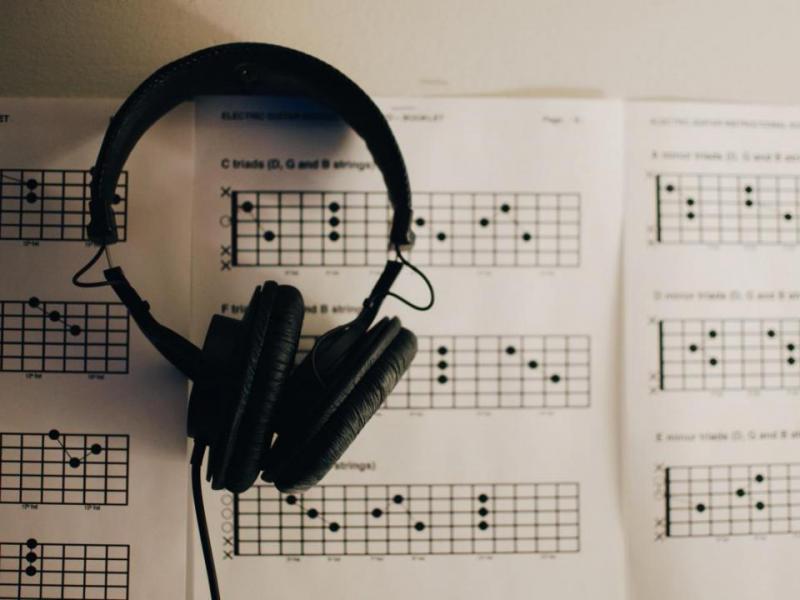
This question comes up again and again: why take music theory lessons? (in French)
Is it really necessary? The very idea puts many people off.
It all depends on your goals. Do you want to play the guitar now and then for pleasure? Is your aim to strum a few chords to accompany yourself singing? Do you want to play a few songs with friends on a Sunday afternoon?
In those cases you can get by without music theory. There are alternative approaches, especially for the guitar, which has the advantage of offering another way of writing music: tablature.
Now, if you want to become an accomplished guitarist, able to play several styles, to join bands active on the regional or national scene, to compose and so on, then there is no way around it: music theory will have to be on your list of things to learn.
You may be thinking: yes, but some great guitarists and musicians did great things without knowing any theory! True, but they belong to the 0.01% of extremely talented artists. Do you really feel you are in the same league as Jimi Hendrix?
A striking analogy is with the French language. Music theory lets you read and write music. Imagine learning French without learning to read or write: you can see the limitations straight away! Well, it's the same with music theory.
How do I position my hand on the guitar neck?

The guitar neck: where you choose the notes you are going to play
The neck will certainly give you the most work as you learn, because that is where everything happens.
Usually made of wood, the neck carries the guitar's strings, generally six of them. Perpendicular to the strings you will see a series of metal bars: these are the frets.
The frets divide the neck into lots of small boxes. Pressing a string down inside one of these boxes "pinches" the string against the two neighbouring frets.
The number of frets varies from one model to another. It is rarely fewer than 19 on standard guitars, and can exceed 22 on some electric guitars.
What are they for? The frequency a string produces (that is, the note: an F, a C, an E) depends mainly on two factors: the length and the density of the string. Pressing a string down along the neck shortens the length that vibrates, and the shorter it is, the higher the note!
The boxes are laid out to match a chromatic scale: a semitone separates each box, a bit like moving from one note to the next on a piano without skipping any.
That is why the boxes never indicate a specific note. Each of the six strings pressed at the same box gives a different note, because the second decisive factor, the density of the string, differs each time. The denser (or, to keep it simple, "heavier") a string, the lower the sound.
In fact, the same note appears several times on a guitar neck, on different strings.
One important thing to know from the start is the note each string gives when played open, that is without pressing any box on the neck.
The highest string is an E, then B, G, D, A, and finally another E for the lowest string.
How do I assess my level on the guitar?

Queen: a legendary band with an outstanding guitarist, Brian May
You have been playing the guitar for a while now and want to know where you stand? It is a useful exercise, because measuring your progress is a great source of motivation.
Ask yourself: am I still a complete novice? Am I starting to have some ability on the guitar, or do I already feel I have serious skills?
To assess your level properly, though, it won't be enough to run a little test sitting comfortably in your room, on your usual chair, with your beloved guitar.
It is in difficult and unfamiliar situations that you will see whether your technique holds up. You will quickly notice that at first, when you leave your comfort zone, your playing takes a hit.
This effect fades with the years and with practice. So how do you create uncomfortable situations? A few ideas:
- Play in front of your friends and family.
- Play after a short night, when you haven't slept enough.
- Play when you are stressed.
- Borrow other guitarists' guitars.
- Play somewhere noisy.
- Take a break of a few days, then pick up your guitar again: still as good?
- Challenge yourself and join a band as soon as you can!
- Play at unusual temperatures.
At first you may think there is no real point in going that far; after all, it's a bit extreme, isn't it? Well, these situations are exactly what a professional musician on tour goes through. That may not be your goal, but they remain interesting ways to measure yourself.
Now, a few pointers to work out your level according to your skills:
- Novice: you can play your first chords and accompany a few songs. Mistakes are still common and a sense of rhythm isn't really among your talents yet.
- Beginner: your rhythm is developing, you are starting to "feel" it. The basic chords hold no secrets for you. You play more and more songs, still simple ones, but you get through them without mistakes. If you sing, you are starting to be able to sing while accompanying yourself on the guitar.
- Intermediate 1: you are getting to know the neck of your instrument and move around it more and more. You are picking up some harmony and music theory. Your chords are gradually getting more complex and you are starting to improvise while singing.
- Intermediate 2: the neck holds no more secrets for you. You have no trouble playing any of the basic chords. Your sense of music and rhythm is developed, and so is your knowledge of harmony.
- Advanced and beyond: it would be wrong to say that the advanced level is the last one. In reality, we could add dozens more. The beautiful thing about music is that you never finish learning or improving!
How do I progress on the guitar?

Playing in a band: one of the keys to getting better
Like any instrument, the guitar is hard at the beginning. You don't know where to start or in what order to go. Setting off alone, self-taught, takes great strength of mind and a lot of motivation.
To help you, we have written a complete article on the subject: how to progress on the guitar (in French).
It contains all the advice you need to start well. If we had to sum it up, one of the main pieces of advice is to get help at the beginning from a competent guitar teacher. They will be a precious source of motivation and will let you work the right way, straight to the point.
They will also correct your mistakes and keep you from settling into bad habits, which can be hard to shake later on…
So, do you feel ready to get started?
Want to give it a try?
A class every week or a camp during the holidays
Going further
Want to try it yourself?

Also worth reading
More articles

How to make the most of learning the piano
Chapters Learning the piano: first, work on hand independence Learning the piano: what is music theory? Rhythm in learning the piano Learning the piano: reading and playing at the…
Read the article
How to progress on the guitar
Contents Warming up on the guitar: an essential prerequisite The metronome: your best ally as an apprentice guitarist Hold back and play slowly! Learning chords: an important step…
Read the article
How to work on your voice
1. Warming up the voice 2. Breathing exercises 3. Projecting the notes 4. The "nasal sound" 5. How to sing in tune 6. Working on diction 7. Vocalises 8. Tongue position A few…
Read the article